

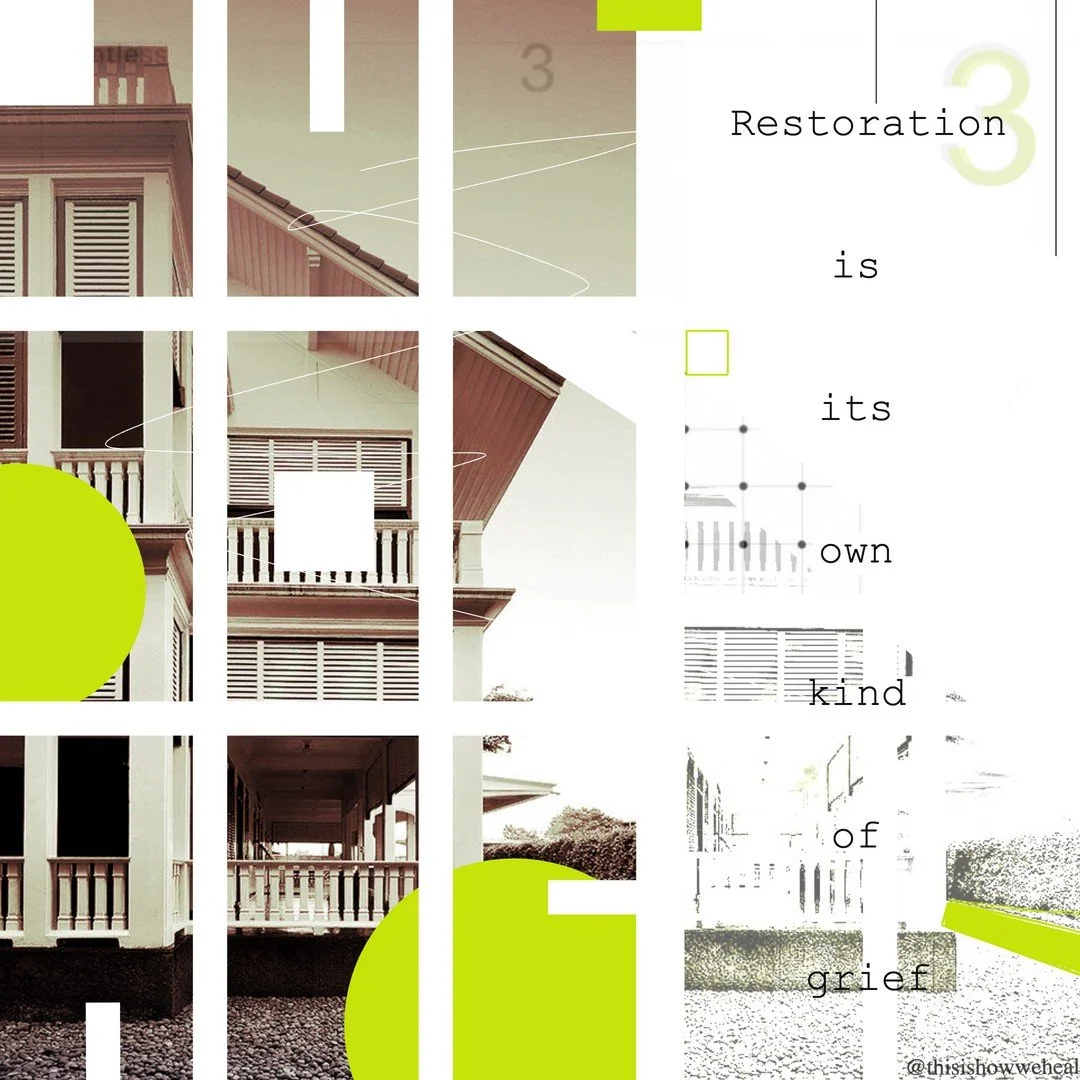
Restoration is its Own Kind of Grief
A good friend of mine in Holland has been living in the same apartment for decades.
Much like me, he’s a creature of habit. Finds comfort in things staying where they’ve always been.
But recently he started renovating.
Sourcing contractors. Thinking about insulation, wiring, layout… trying to make it work better for how he’s living now.
“I hate renovation. I just don’t like it.”
He texted me the other day. Half-laughing, half-exhausted, I imagine.
_
You might be wondering why I’m harping on about a Dutch man renovating his apartment.
Well, because I think it’s a great analogy for grief… how it can sometimes look like.
The structure is still there.
But something inside the house has changed.
“We must learn to cope with the stress of restoration…”
Psychologists Henk Schut wrote when he developed his model of coping with bereavement.
Restoration. Interesting use of word isn’t it?
Because rebuilding while still living inside the space is draining.
You’re not moving away from your old life.
You’re restoring it so it can still be lived in.
Over time, you settle.
The intensity of grief does loosen.
It visits less often, with less force.
You learn to live with this loss.
But alongside, there’s also this quieter, ongoing work of restoration.
—
And if you think about it… renovation is never really finished.
Even after the big work is done, something else shows up.
A new leak.
A chipped tile.
More things need fixing.
Perhaps a meaningful life is never something we finish building.
As long as we’re living, we’re still working on it.
In that sense, grief doesn’t really end too.
Because the need to restore our lives keeps returning, as we discover new losses that the death of a loved one creates.
You step into a new chapter…and realise the one person you want to tell isn’t there.
You try to cook a dish they made perfectly… and along the way, you lose your appetite.
So no.. grief does not really end.
Because life keeps moving.
And every now and then,
something else in the house asks to be reworked.
Not replaced.
Just… restored.
If you found this post helpful, feel free to share it with someone who might benefit!
Warmly,
George Chan
This Is How We Heal

George Chan, MCOU, is a Counsellor, Grief Educator and Breathwork Coach who specialises in helping individuals navigate grief and loss through his private practice, This Is How We Heal. With a rich background in theatre and entertainment, George brings creativity and empathy to his work. When he's not in the therapy room, you might find him performing, choreographing, or working on a new production—or spending time with Luna, his Jack Russell Terrier, who doubles as his unofficial co-therapist and production critic.